
U.S. News Releases Best Jobs Rankings! This Profession Claims the Top Spot for Three Consecutive Years

As we all know, selecting a high-demand and promising major is of paramount importance to one’s career trajectory. Popular majors often align with robust market demand, translating to more employment opportunities and higher placement rates for graduates.

So, which career path should you choose? Let’s look at the recently released U.S. News 2026 Best Jobs Rankings for guidance!
This report evaluates the top positions across 17 different industries, providing job seekers with essential benchmarks regarding career advancement, work-life balance, and salary expectations.

This is currently one of the most authoritative and data-driven career outlook assessments in the United States. By analyzing over 200 occupations across multiple dimensions—including salary, employment growth, market demand, job stability, and work-life balance—the rankings outline a high-potential professional blueprint for the next decade.
Ranking Methodology
The data is sourced from the U.S. Bureau of Labor Statistics (BLS) and is based on five key metrics:
Future Growth Rate (30% weight): Projected change in job openings over the next 10 years.
Salary (25% weight): Median income and potential for salary growth.
Employment Market (20% weight): Number of current roles, unemployment rates, and barriers to entry.
Job Stability (15% weight): The profession’s resilience against economic fluctuations and risk.
Work-Life Balance (10% weight): Working hours, stress levels, and remote work possibilities.
This list measures which professions are most worth entering over the next 10 years. Today, we will break down the "Top 10" performers and analyze what this data means for the next generation.
1. Nurse Practitioner

Industry: Healthcare
Unemployment Rate: 0.6%
Median Salary: $129,210
Projected Job Openings: 128,400
Nurse Practitioners are the "star" of the healthcare industry, securing the #1 spot for three consecutive years due to exceptionally low unemployment and competitive pay. They handle everything from diagnosis to managing medical equipment. As the population ages, this role is a critical solution for the healthcare system. The path typically begins with a Bachelor of Science in Nursing (BSN), followed by a Master’s (MSN) or a Doctorate (DNP).
2. Financial Manager

Industry: Business
Median Salary: $161,700
Unemployment Rate: 1.4%
Projected Job Openings: 128,800
This role requires a deep understanding of an organization’s economic health, financial decision-making, and regulatory compliance. It demands mastery of banking, securities, insurance, and increasingly complex financial tools. Most candidates hold degrees in Finance or Accounting and pursue certifications like CFA or CPA mid-career. It highlights a common trend: the "ceiling" for many careers isn't technical skill, but the ability to transition into management.
3. IT Manager

Industry: Technology
Median Salary: $171,200
Unemployment Rate: 1.4%
Projected Job Openings: 101,600
IT Managers coordinate with executive leadership to plan software/hardware upgrades and negotiate with vendors. They must be tech-savvy but, more importantly, they must translate technical solutions into business language for non-technical executives. This role is highly resilient in the AI era because machines cannot easily replace a manager who balances engineering logic with human resource coordination.
4. Information Security Analyst

Industry: Technology
Median Salary: $124,910
Unemployment Rate: 0.8%
Projected Job Openings: 52,100
With a job growth rate of 28.5%, this is one of the fastest-growing roles on the list. As cyberattacks become more frequent, experts in digital defense are essential. While it offers high stability in a remote-work world, the intensity is high; analysts are often "on-call" to respond to security emergencies.
5. Physician Assistant

Industry: Healthcare
Median Salary: $133,260
Unemployment Rate: 1.6%
Projected Job Openings: 33,200
Physician Assistants (PAs) diagnose illnesses and develop treatment plans much like doctors, but with a shorter training cycle (usually a Master’s degree following a Bachelor’s). This is an excellent path for students who want to enter the medical field quickly without the lengthy residency required of MDs.
6. Medical and Health Services Manager

Industry: Healthcare
Median Salary: $117,960
Unemployment Rate: 1.5%
Projected Job Openings: 142,900
Hospitals need administrators as much as they need doctors. These "behind-the-scenes" planners ensure that clinics and nursing homes run efficiently. Demand is surging as the Baby Boomer generation requires more managed care.
7. Software Developer

Industry: Technology
Median Salary: $133,080
Unemployment Rate: 3.2%
Projected Job Openings: 267,700
While this role has the highest absolute number of projected new jobs, the industry is undergoing structural changes. The rise of AI tools has reduced the need for junior "generalist" coders. However, specialized fields like AI/ML Engineering, Cybersecurity, and Infrastructure remain in a talent shortage. To succeed, students must focus on deep logic and AI-integration rather than just basic coding.
8. Data Scientist

Industry: Technology/Business
Median Salary: $112,590
Unemployment Rate: 1.1%
Projected Job Openings: 82,500
Data Science addresses the core challenge of the digital age: extracting meaningful insights from massive, complex datasets to guide business strategy. With the large-scale implementation of AI, demand for this profession will only intensify.
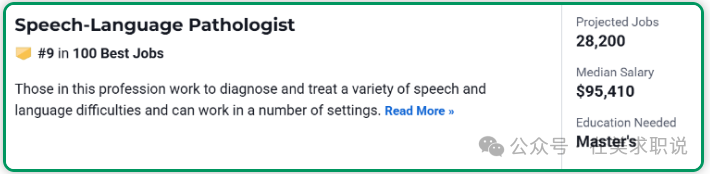
9. Speech-Language Pathologist
Industry: Healthcare
Median Salary: $95,410
Unemployment Rate: 0.7%
Projected Job Openings: 28,200
These specialists assess and treat speech, language, and swallowing disorders. It is an incredibly stable medical-related profession in the U.S., driven by the needs of both children and the aging population in rehabilitation centers and nursing homes.
10. Pilot

Industry: Transportation
Median Salary: $226,600
Unemployment Rate: 1.2%
Projected Job Openings: 3,900
This is the highest-paid occupation on the list. Although the growth rate is slower, the industry faces a structural deficit due to the rigorous training hours and certification requirements. It is a unique path that relies more on flight-hour accumulation than traditional academic degrees.



Comments