
“30 Careers to Be Eliminated by AI”? The Truth: Data from 744 U.S. Occupations Reveals Future Employment Trends

Lately, anxious topics surrounding AI and employment have been surfacing frequently: "Telemarketers are vanishing," "Customer service roles will be replaced by AI," "The translation industry is being rendered obsolete by artificial intelligence..."

Some have even claimed that 30 types of occupations will gradually disappear in the near future, implying that college graduates might enter the workforce with already-outdated degrees. For international students preparing for graduation, applying for OPT, and job hunting in the U.S., such news can easily trigger anxiety: Is the degree I spent four years earning still going to be competitive? However, looking back at the raw research behind these claims reveals that things are not nearly as simple.
What actually sparked the debate was not a "career hit list," but a new metric introduced by Yale University’s The Budget Lab: AI Exposure. It does not measure "which jobs will disappear," but rather: which occupations are changing the way they work because of AI.
The Origin Story of "30 Careers Disappearing"
This debate originated from a study released by Yale’s The Budget Lab. The research team constructed a data framework covering 744 U.S. occupations to calculate an AI Exposure index for each profession. In short, AI Exposure measures how many tasks within a job are likely to be affected by generative AI.
Subsequently, the U.S. educational research organization College Transitions combined this data with 10-year employment projections and wage data from the U.S. Bureau of Labor Statistics (BLS). They sought to answer one core question: Do occupations with higher AI impact face worse future employment prospects? The results were unexpected for many.
Data shows that among occupations with higher AI Exposure, roughly 70% are still projected to grow over the next decade. Out of 372 occupations with above-median AI Exposure:
264 occupations are expected to see employment growth;
108 occupations are expected to decline.
There is virtually no negative correlation between the two. In other words: High AI exposure does not mean a career is destined to disappear.
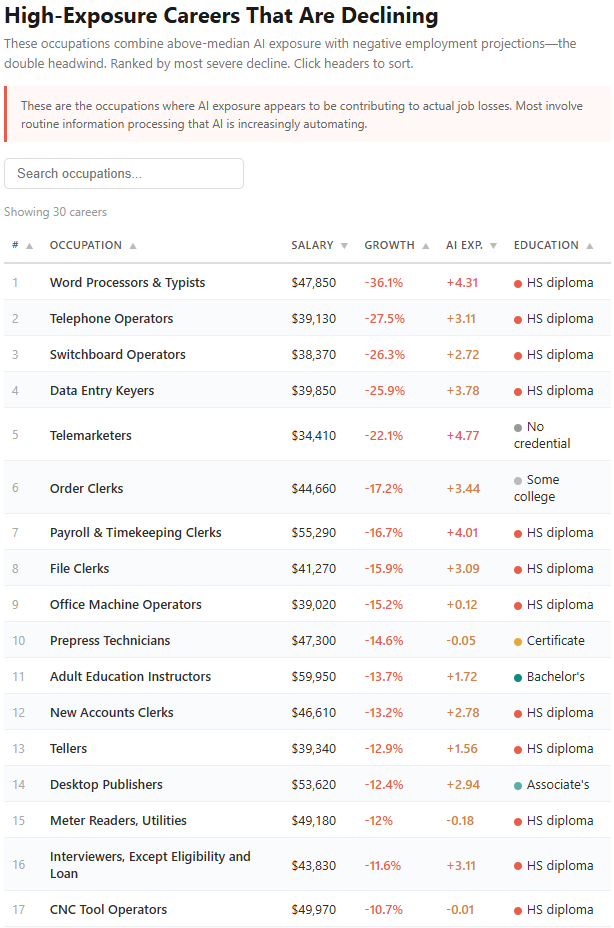
Later, College Transitions compiled a list of occupations that both feature high AI Exposure and are projected to decline in future employment. These included roles such as telemarketers, data entry keyers, and desktop publishers.
These specific roles were subsequently packaged by certain media outlets as "30 Careers AI Is About to Eliminate." In reality, research institutions never framed it this way. What they genuinely intended to illustrate was that highly standardized, repetitive jobs are more likely to transition from "AI-assisted" to "AI-replaced."
What Does AI Exposure Actually Mean?
Many misinterpret AI Exposure by equating it directly with "risk of AI replacement." But the two are fundamentally different. AI Exposure focuses on how many tasks AI can participate in, not whether the entire profession will vanish.
Take a Business Analyst as an example. Their responsibilities might include:
Gathering and organizing data
Building models
Analyzing trends
Presenting recommendations to management
AI can rapidly accomplish the first two steps, drastically boosting efficiency. However, what enterprises ultimately require is a human who understands the business context, judges whether the results are sound, and makes strategic decisions. Therefore, while such roles have high AI Exposure, they will not simply disappear.
According to College Transitions’ analysis of 744 occupations, many high AI Exposure careers continue to grow:
Data Scientists / Analysts
Software Developers
Financial Managers & Consultants
Marketing & Product Managers
The common denominator among these roles is that AI helps complete portions of the work, but the true value-adding components—such as judgment, professional experience, commercial insight, communication, and trust-building—still rely on humans.

Conversely, roles prone to decline share distinct traits: fixed workflows, high repetitiveness, limited room for discretion, and a heavy reliance on data entry or simple operations. Ultimately, what changes in the future is rarely an entire profession, but rather specific tasks within it.
What Does AI Exposure Mean for International Students?
For international students currently seeking employment in the U.S., the most crucial takeaway from this research is not a list of majors to avoid, but a clear signal: corporate hiring standards are evolving.
1. AI Proficiency Is Becoming a Foundational Competency
In the past, employers looked for proficiency in tools like Excel, SQL, and data analytics. Moving forward, AI tools will become a similar baseline requirement. Whether in finance, consulting, marketing, product management, software development, or data analytics, employers will increasingly evaluate: Can you leverage AI to boost efficiency and solve real-world problems?
Future competition won't be "Will AI replace you?" but rather "Will people who know how to use AI replace those who don't?"
2. The Importance of Practical Experience Is Rising
AI has lowered the barrier to entry for many foundational tasks. As a result, relying solely on grades and coursework is no longer enough to prove workforce readiness. For international students, what matters far more than GPA is:
Whether you have hands-on project experience
Whether you have participated in real-world business environments
Whether you have solved actual problems
Whether you can demonstrate tangible deliverables
This explains why American universities and employers have placed increasing emphasis on Career-Connected Learning in recent years.
3. Cultivating Irreplaceable "Human Advantages"
In the era of AI, what international students should focus on upgrading is not merely learning more tools, but building their unique human edge, including:
Complex Problem-Solving: The ability to analyze information and weigh choices when faced with open-ended problems.
Cross-Disciplinary Abilities: Connecting technology, business logic, and industry needs.
Communication & Collaboration: Establishing trust with clients and multidisciplinary teams.
Continuous Learning Capacity: Rapidly adapting to new technologies and evolving role requirements.
These core capabilities are the true sources of long-term career competitiveness.
Final Thoughts
AI is not ushering in an era of simple "job destruction." More accurately, we are entering an era where careers are constantly being redefined. Yale University introduced the concept of AI Exposure not to predict which jobs will vanish, but to help us understand that nearly all professions will be touched by AI—just in vastly different ways.
For graduating international students, instead of worrying about whether "my major will be eliminated by AI," the more important question is: As AI handles more foundational tasks, what unique, irreplaceable value can I create? The truly sustainable competitive advantage of the future does not lie in a specific degree title, but in your ability to solve complex problems, learn continuously, and work synergistically alongside AI.


Comments